
Where the Gap Exists in the Acquisition Chain
Most performance models assume a linear flow:
- Paid Click → Landing Page → Lead → Revenue
This model omits the most important condition:
The landing page must first be reached in a usable state
before any conversion can occur.
In practice, a portion of paid traffic never reaches that state.
Load latency, mobile instability, and early friction
prevent the session from forming.
You are not just losing conversions.
You are losing arrivals.
The corrected model looks like this:
- Paid Click → Attempted Arrival → Usable Session → Lead → Revenue
The Yield Gap exists between attempted arrival and usable session.
This stage is rarely measured directly, yet it determines how much of your paid demand can ever convert.
Quantify the Gap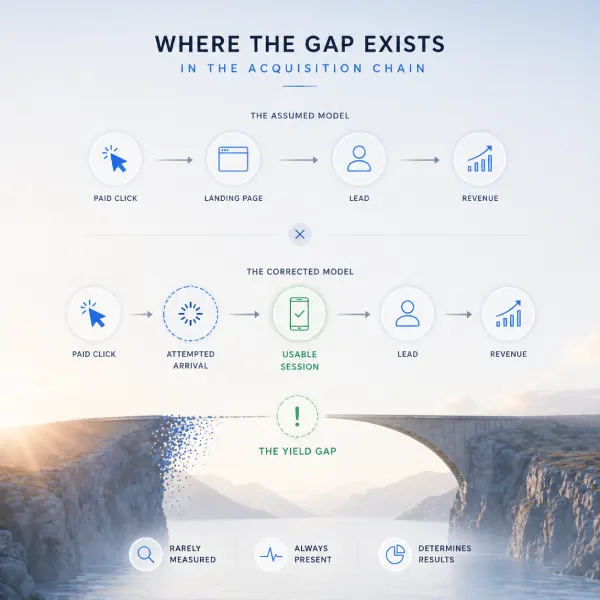
Why Standard Metrics Fail to Capture It

Closed-System Assumption
Most reporting assumes that a paid click results in a real page session. If the session never forms, the loss occurs outside the measurement model entirely.

Binary Page Status
Pages are treated as either “working” or “not working.” In reality, usability exists on a spectrum, and partial failure is where most loss occurs.

Attribution Drift
When arrival failure is not isolated, performance issues are misattributed downstream to conversion rate, lead quality, offer strength, or sales process.

The Financial Effect of Unmeasured Arrival Loss
The Yield Gap does not appear as a direct line item.
Instead, it manifests indirectly across multiple performance metrics:
- Elevated cost per lead without clear cause
- Inconsistent lead volume under stable spend
- Lower-than-expected conversion rates
- Increased dependence on higher budgets to maintain output
Because the loss is unmeasured, it is usually compensated for rather than corrected.
More spend is added to offset what was never captured.
You are not scaling performance. You are compensating for loss.
At scale, this becomes a structural inefficiency in the acquisition system.
The result is suppressed revenue capture and reduced acquisition efficiency at the EBITDA level.
Quantify the GapIf the system cannot measure arrival, it cannot optimize it.
And if it cannot optimize it, the loss persists regardless of spend or strategy.
Quantify the GapHow the Yield Gap Is Isolated
You cannot see this clearly in standard reporting alone.
It must be measured through controlled comparison.
A portion of paid traffic is routed into an environment optimized for:
- Sub-second mobile load performance
- Tight intent alignment
- Minimal friction to first interaction
That traffic is then compared against your current environment.
The difference between:
- attempted arrivals
- usable sessions
- captured leads
reveals the size of the gap.
This is not modeled. It is observed directly.
Start Measurement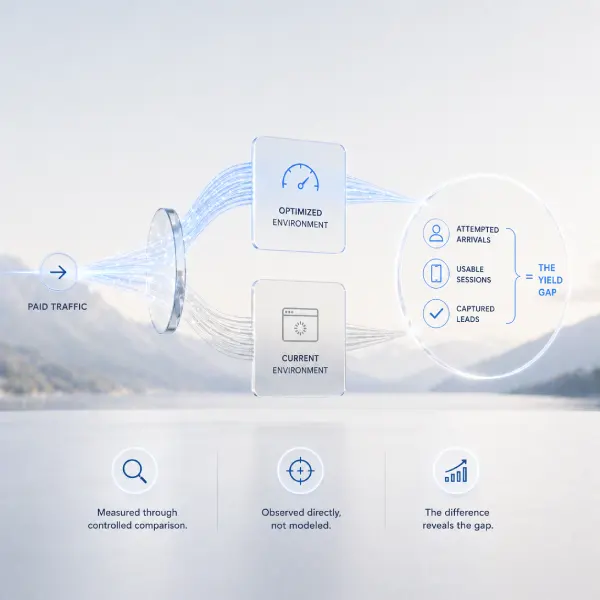
Defines a missing variable in the paid acquisition model that standard reporting does not capture.
Separates arrival failure from downstream conversion performance.
Connects technical performance directly to financial output.
Creates a measurable path to validate acquisition efficiency without assumption.